Desiccant compressed air drying
Compare moisture targets with regeneration air, electricity and maintenance needs.
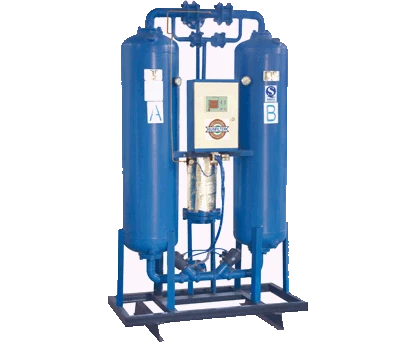 Manufacturer reference photo · fsair.cn
01Define the operating duty
Set the dew-point target from separator and process requirements. Regeneration methods differ in electricity, purge air and operating conditions. Compare them at equal flow and inlet conditions rather than choosing the lowest advertised dew point.
- Demand input: Dew-point specification
02Connect the complete system
Include regeneration air in compressor capacity and review filtration, silencers, exhaust and servicing. Heated regeneration also needs power and control interfaces. Connection diameter alone does not establish the installation or utility scope.
- Interface input: Regeneration method; Permitted regeneration air
03Verify the configuration
Test a complete regeneration cycle and assess variation rather than one minimum reading. Maintain media and valves according to condition. Review pressure drop, regeneration effectiveness and instruments as part of the full quality chain.
This topic describes station auxiliaries. Confirm compatibility, quantities and supply boundaries against the system diagram. The fields below collect project requirements and do not represent a fixed model rating.
- Verification input: Inlet moisture and filtration
Selection conditions to confirm
| Item | Requirement / confirmation basis |
|---|---|
| Dew-point specification | Confirm for the projectProvide actual process conditions and the measurement basis. |
| Regeneration method | Confirm for the projectSpecify normal values, peaks or the permitted range. |
| Permitted regeneration air | Confirm for the projectCheck against existing equipment and site conditions. |
| Inlet moisture and filtration | Confirm for the projectAgree the acceptance basis during technical review. |
These public references explain general technology. They do not establish AIDEKE model performance, a supply commitment or a third-party endorsement. The article is an independent editorial explanation; the confirmed technical agreement governs a specific project.
Sources and usage notes